-
Oak Brook
📍📞 630-705-99992625 Butterfield Rd. Suite 102E
Oak Brook, IL 60523📠 Fax: 630-705-1422✉️ inquiry@vervecollege.edu 🗺️ Open in Google Maps 🍎 Open in Apple Maps🕒Office HoursMon–Fri: 9:00 AM – 6:00 PM
Sat: 10:00 AM – 4:00 PM
Sun: Closed -
Chicago
📍📞 312-920-8822216 W. Jackson Blvd. Suite 900
Chicago, IL 60606📠 Fax: 312-658-0775✉️ inquiry@vervecollege.edu 🗺️ Open in Google Maps 🍎 Open in Apple Maps🕒Office HoursMon–Fri: 9:00 AM – 6:00 PM
Sat: 10:00 AM – 4:00 PM
Sun: Closed - Email:inquiry@vervecollege.edu
- Make a Payment
 Sign up
 Login
Login
- Home
- Programs
- Admission
- Resources
- ATI Entrance Exam Resources
- New E-Digital Library
- Refer a Friend
- School Newsletter
- Events
- Employers
- Job-Network
- Alpha Beta Kappa Candidates
- Verve College Library
- Graduation and Pinning Ceremony Photo Galleries
- Textbook Information
- Career Services
- Tutoring
- School Catalog
- FAQ
- Constitution Day Program
- Alumni
- Verve College Plans
- Financial Aid
- HEERF Reporting
- Satisfactory Academic Progress
- Apply For Financial Aid
- Net Price Calculator
- Return of Title IV Funds (R2T4)
- Financial Aid Office Code of Conduct
- Contact
- FAQs
- Verification Policy
- Vaccination Policy
- Student Right-to-Know Act
- Misrepresentation
- Information Security Program
- Academic Award Year
- Availability of Employee
- Cost of Attendance
- Health & Safety Exemption Requirement
- Students Rights and Responsibilities
- Leave of Absence
- Pell Formula
- Military Students
- Grants/ Scholarship Policy
- Contact Us
- Testimonials
- Blog
Is a Nursing Career Right For You?
Take The Free Quiz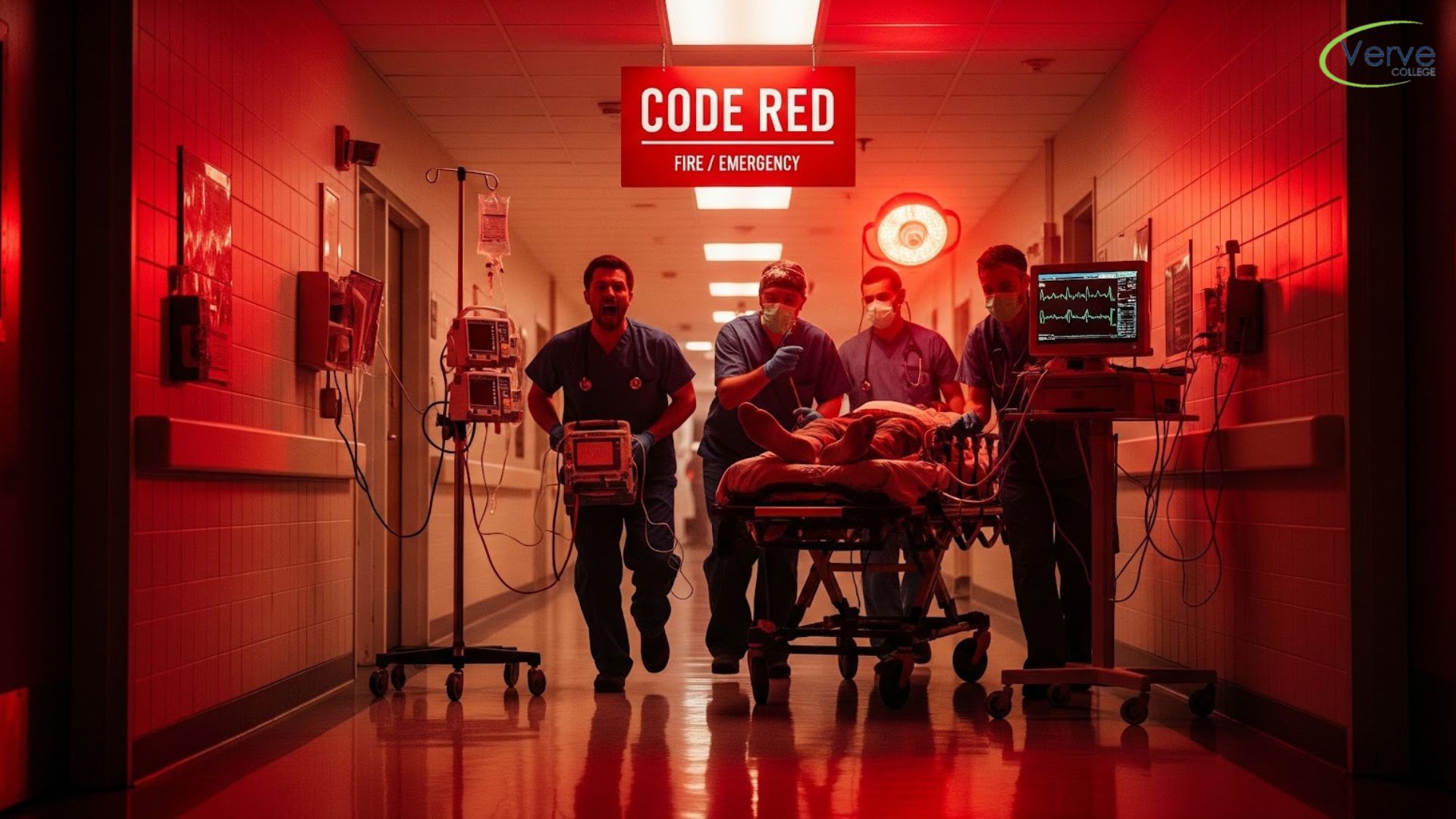
Code Red in Medical Settings: Full Guide
Code Red in Medical Settings: Full Guide
According to the National Fire Protection Association (NFPA), U.S. fire departments respond to more than 1.3 million fires each year, and healthcare facilities are considered high-risk environments because patients may not be able to move on their own. In hospitals and long-term care centers, even a small fire can quickly turn into a life-threatening hospital emergency codes. That is why clear emergency codes are used.
Understanding the meaning of code red in hospital settings is critical for healthcare workers, students, and even visitors. These color codes allow staff to respond immediately without creating panic. Whether you are exploring nursing degrees in Illinois or already working in patient care, knowing what a Code Red means is part of basic healthcare safety knowledge.
Key Takeaways
- Code Red usually means there is a fire or smoke emergency inside the facility.
- Hospitals follow a structured system called RACE (Rescue, Alarm, Contain, Extinguish/Evacuate).
- Quick response protects patients who may not be able to walk or move easily.
- Staff receive regular fire drills and emergency response training.
- Code Red procedures differ slightly between hospitals and nursing homes.
What is Code Red in a Hospital?
When someone announces “Code Red” in a hospital, it almost always means there is a fire or suspected fire in the building. It could be visible flames, smoke, or even a burning smell coming from equipment or wiring.
Hospitals do not shout “fire” over the loudspeaker because it may cause panic among patients and visitors. Instead, the coded phrase alerts trained staff while keeping the environment calm.
Once a Code Red is called:
- Staff identify the exact location.
- The nearest employees begin the emergency protocol.
- Fire alarms may be activated.
- The fire department is notified if needed.
The goal is fast control with minimal disruption to patient care.
Why Code Red is So Serious in Healthcare Settings?
Code Red is so serious in healthcare settings because patients often cannot protect themselves. Many are connected to oxygen, IV lines, or life-support machines. Others may be recovering from surgery or unable to walk. Even a small fire can quickly become life-threatening in this environment.
Hospitals are complex buildings with critical equipment and vulnerable people in every department. Evacuating patients is not simple. Staff must carefully move them while keeping treatments stable. This requires quick thinking, teamwork, and clear communication.
Although hospitals have fire-resistant walls, alarms, and sprinkler systems, technology alone is not enough. The real protection comes from trained healthcare workers who respond immediately and follow emergency protocols. Their fast action helps prevent injuries and saves lives.
RACE Protocol: How Staff Respond?
Most hospitals follow the RACE system during a Code Red. This step-by-step process ensures everyone knows their role.
R – Rescue
First, remove anyone in immediate danger from the area. This may include moving patients to a nearby safe room.
A – Alarm
Pull the fire alarm and notify the switchboard or emergency system to officially announce Code Red.
C – Contain
Close doors and windows to prevent smoke and fire from spreading. Hospitals are designed with fire doors that slow down flames.
E – Extinguish or Evacuate
If the fire is small and the staff are trained, they may use a fire extinguisher. If not, they prepare for evacuation.
Many students in licensed practical nurse programs in Chicago learn these emergency procedures early in their clinical training because quick thinking saves lives.
Fire Extinguisher Training: The PASS Method
Along with RACE, healthcare workers are taught the PASS method for using a fire extinguisher:
- P – Pull the pin
- A – Aim at the base of the fire
- S – Squeeze the handle
- S – Sweep side to side
However, staff are trained not to take risks. If the fire is spreading quickly, evacuation becomes the priority.
Code Red in Different Healthcare Settings
While hospitals and nursing homes both use Code Red, the response may differ slightly depending on the building and patient population.
Code Red in Intensive Care Units
ICUs contain advanced equipment and critical patients. Staff must move life-support systems carefully. In many cases, horizontal evacuation (moving patients to another safe section on the same floor) is preferred instead of using stairs.
Code Red in Nursing Homes
Elderly residents often need assistance with mobility. Evacuation plans are slower and more coordinated. Fire drills are especially important in long-term care facilities to ensure staff can respond efficiently.
Because nursing homes house vulnerable populations, fire prevention is heavily regulated and inspected.
How Often Are Fire Drills Conducted?
Healthcare facilities are required to conduct regular fire drills. Many hospitals perform drills quarterly on each shift. This ensures:
- Day and night staff are equally prepared
- New employees understand protocols
- Weak points in the system are identified
Fire drills may be announced or unannounced. The purpose is to simulate real emergencies without creating fear.
Technology and Fire Prevention
Modern hospitals use:
- Smoke detection systems
- Automatic sprinklers
- Fire-resistant walls
- Backup power systems
Electrical equipment is regularly inspected because faulty wiring is a common cause of facility fires. Staff are also trained to recognize early warning signs such as overheating equipment or unusual smells.
Role of Nurses During Code Red
Nurses are central to emergency response. They must:
- Protect patients first
- Stay calm
- Communicate clearly
- Document the incident afterward
Even students in training programs learn that emergency preparedness is as important as clinical skills. Flexibility in education, including options like Night and Weekend LPN Programs, allows working adults to gain these critical skills while balancing other responsibilities.
Common Mistakes During Code Red
Despite training, mistakes can happen. Common issues include:
- Delayed alarm activation
- Poor communication
- Blocking hallways during evacuation
- Panic among untrained visitors
Facilities work continuously to improve safety culture and reduce these risks.
Conclusion
Understanding the code red meaning at hospital settings is not just for healthcare workers. It reflects how seriously medical facilities take patient safety. Code Red signals a fire emergency and activates a clear, structured response system designed to protect vulnerable patients.
From RACE protocols to fire drills and modern prevention systems, healthcare environments rely on preparation and teamwork. Whether in hospitals, ICUs, or long-term care facilities, knowing what to do during Code Red can prevent injuries and save lives.
Frequently Asked Questions (FAQs)
- Who is allowed to announce a Code Red?
Usually, any staff member who discovers smoke or fire can activate the alarm system. The switchboard then officially announces Code Red overhead.
- Does Code Red always mean visible flames?
No. It can also mean smoke, a burning smell, or suspected fire risk. Quick action prevents small issues from becoming large disasters.
- Are visitors told what Code Red means?
Not always directly. Hospitals use coded language to avoid panic. Staff guide visitors calmly during the situation.
Most Popular Blogs Posts

What Is Cardiac Output? A Simple…
October 6, 2026 Read More
What Should You Look for in…
October 6, 2026 Read More
How LPN Training Prepares Students for…
October 5, 2026 Read More
What Is Inflammation? A Simple Guide…
October 1, 2026 Read More